
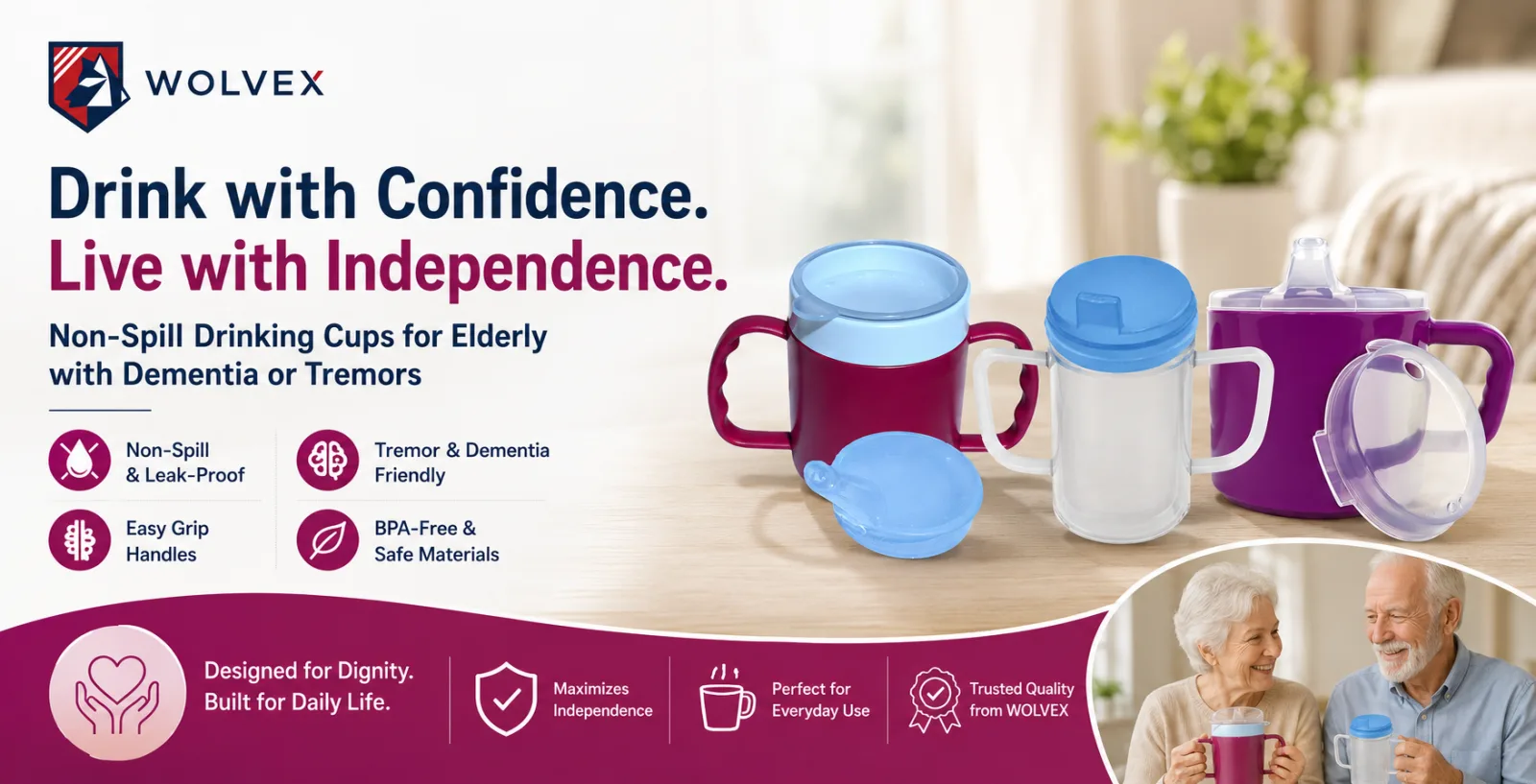
If you care for an elderly parent who has dementia, Parkinson's, or arthritis, you already know the moment we're talking about: a cup tips, a drink goes everywhere, and what should have been a simple cup of tea turns into a change of clothes, a change of bedding, and — worse than the mess itself — another small dent in someone's confidence. It happens quietly, over and over, and it's one of the most common (and most fixable) problems families tell us about.
The good news is that this is a solved problem. Non-spill cups designed specifically for adults — not repurposed children's sippy cups — can make drinking safe, dignified, and mess-free again, for people with shaky hands, weak grip, or memory difficulties. This guide covers exactly what to look for, why it works, and which cups actually hold up to daily use.
Why an Ordinary Cup Becomes a Daily Struggle
A standard mug or glass asks a lot of the hand and brain: a firm one-handed grip, steady wrist control, accurate judgement of how full the cup is, and enough coordination to bring it to the mouth without tipping. For most of us, that's automatic. For someone living with dementia, Parkinson's tremors, arthritis, or general age-related weakness, every one of those steps can go wrong.
- Weak grip — arthritis and general muscle loss make it hard to hold a smooth, narrow mug securely, especially when it's full and heavier.
- Tremors — Parkinson's and essential tremor cause involuntary shaking that a normal cup has no way to absorb, so the drink sloshes and spills before it reaches the mouth.
- Memory and dementia challenges — someone may forget a cup is full, put it down at an angle, or lose track of how to tilt it safely.
- Reduced coordination — after a stroke or with advanced Parkinson's, the two-handed "lift, tilt, sip, return" sequence can become genuinely difficult to complete smoothly.
The result isn't just a spilled drink. Families often tell us their loved one starts drinking less altogether, simply to avoid the embarrassment or hassle of spills — and reduced fluid intake in elderly people is a real, serious health risk (more on that below). Solving the spilling problem properly is also solving a hydration problem.
Adult Sippy Cups vs Children's Sippy Cups: Why the Difference Matters
It's tempting to reach for a child's sippy cup from the supermarket — they're cheap, widely available, and solve the "spill" part of the problem. We'd steer you away from that, and not for snobbish reasons.
Children's sippy cups are built around small hands, small mouths, and small drink volumes (often under 200ml). They're usually brightly coloured with cartoon branding, which can feel patronising or undignified for an adult to use at the dinner table or in front of visitors. The spouts are also sized and angled for a child's bite and suck pattern, which doesn't always translate well to adult drinking mechanics — some elderly users find children's spouts awkward or find they have to tip their head back too far, which is a genuine choking risk for anyone with swallowing difficulties (dysphagia).
A proper adult sippy cup is designed from the ground up for grown-up hands and grown-up dignity: neutral, café-style colours; larger capacities (200–350ml, closer to a normal mug); adult-proportioned handles; and spouts engineered for a natural adult sipping angle. It looks like a normal drinking cup on the table, not a piece of baby equipment — which matters more than people expect, especially for someone who is already sensitive about losing independence.
The Case for Two-Handled Cups
If there's one single upgrade that makes the biggest practical difference, it's moving from a one-handed mug to a two handled adult drinking cup. Two handles change the entire physics of the problem:
- Stability — two hands, two contact points, means far less wobble than one hand gripping a single handle or a smooth mug body.
- Lower grip strength needed per hand — the weight of the drink is shared across both hands, which matters enormously for someone with arthritis or general weakness in one side (common after a stroke).
- Better tremor control — two hands bracing a cup naturally dampen shake far more effectively than one hand alone, which is particularly helpful for Parkinson's tremors.
- Easier to relearn — for someone with dementia, a two-handled cup with big, obvious handles is a more intuitive shape to recognise and use correctly, even on a difficult day.
This is why occupational therapists so often recommend two-handled cups as one of the first, simplest pieces of daily-living equipment for elderly clients — it's a small change with an outsized impact on everyday confidence.
Straw Cups vs Spout Cups: Which Is Better?
Both styles have a place, and the right choice depends on the person, not just the condition.
Spout cups (sometimes called "spouted lids" or "sippy lids") control flow through a small opening, so liquid only comes out when the cup is tilted. They're excellent for people who still have reasonably good head and neck control and simply need spill protection during the tilt-and-sip motion. Most of our adult sippy cups with lids use this style as standard.
Straw cups let the person drink without tilting their head back at all — the cup can stay upright on the table while they sip through the straw. This is often the safer, more comfortable option for people with limited neck mobility, swallowing difficulties, or those who spend a lot of time in a reclined chair or in bed. If tilting the head back is difficult or risky, a cup with a straw and lid is usually the better starting point.
If you're not sure which your relative would manage better, it's worth trying both — many of our customers keep one of each on hand and let the person choose, which also helps preserve a sense of control and choice in something as small (and as important) as their afternoon cup of tea.
What "Spill-Proof" Actually Means (and Why Some Cups Fail)
Not every cup marketed as "spill-proof" actually is. There's a real difference between a lid that merely reduces splashing and a genuinely leakproof, non-spill design that survives being knocked, tipped, or dropped by an unsteady hand.
A properly engineered non-spill cup for elderly uses a valve or one-way seal in the spout, so liquid physically cannot escape unless someone is actively sipping and creating suction — even if the cup is knocked over completely. This is a different mechanism to a simple loose-fitting "sippy" spout, which can still dribble under pressure. When you're comparing cups, look specifically for language like "leakproof valve," "anti-spill seal," or "100% spill-proof lid" rather than just "spill-resistant," which is a much weaker claim.
Why Hydration Matters So Much for Elderly People
This is worth dwelling on, because it's the real reason a "simple cup" is worth getting right. As we age, the body's natural thirst signal weakens — many elderly people simply don't feel thirsty even when they need fluids, which means they rely on habit and routine to drink enough, rather than instinct. Add in a physical barrier like spilling, embarrassment, or a cup that's genuinely difficult to use, and fluid intake can drop further, sometimes without anyone noticing until symptoms appear.
Dehydration in elderly people is linked to confusion (which can be mistaken for worsening dementia), urinary tract infections, dizziness and falls, constipation, and low blood pressure — all serious, all avoidable. Removing the friction around drinking — a comfortable, secure, spill-proof cup that's genuinely easy to use — is a small, low-cost step that protects against a surprisingly long list of health problems.
A Familiar Scenario
We hear a version of this story often, so it's worth telling in full — you'll probably recognise parts of it. A daughter is caring for her mother, who has moderate dementia and increasingly noticeable hand tremors. Every cup of tea has become a small event: a folded towel kept permanently on the arm of the chair, a fresh cardigan on standby, and a quiet dread every time a drink is poured. Her mother has noticed too — she's started refusing drinks in front of visitors, and drinking less water generally, "to avoid the fuss."
The fix wasn't a complicated one. Switching to a two-handled, genuinely leakproof cup meant her mother could hold it confidently with both hands, the tremor no longer caused spills even when the cup was set down slightly off-balance, and — just as importantly — she stopped worrying about it. Within a couple of weeks, the towel came off the arm of the chair. That's the actual goal here: not just a dry table, but one less thing for someone to feel anxious or embarrassed about every single day.
Caring for a Spill-Proof Cup: Cleaning and Everyday Use
A detail that's easy to overlook until you're living with it day to day: whoever is caring for an elderly relative needs this cup to be genuinely low-maintenance, not just spill-proof. A handful of practical points make a real difference over weeks and months of daily use:
- Dishwasher safe is non-negotiable. A cup that needs careful hand-washing (especially one with a valve or narrow spout that's fiddly to clean properly) will eventually get skipped or cleaned poorly, which matters for hygiene as much as convenience.
- Fewer, simpler parts last longer. Cups with a huge number of small components (multiple valves, several loose seals) are more likely to have a piece go missing or wear out. A well-designed lid does the job with the fewest possible moving parts.
- Replaceable lids matter. Lids wear out well before the cup body does — being able to buy just a replacement lid, rather than the whole cup, is a small but genuinely useful feature to look for.
- BPA-free plastic or food-grade materials hold up better to repeated dishwasher cycles without degrading, discolouring, or retaining odours and stains from tea or coffee.
None of this is complicated, but it's exactly the sort of detail that separates a cup that gets used every day without a second thought from one that quietly ends up back in the cupboard after a few weeks.
Choosing the Right Cup: A Practical Buyer's Checklist
Before buying, run through this checklist. A cup that ticks every box will genuinely solve the problem, rather than just being a slight improvement on what you already have.
- Two handles — for grip stability and shared weight, especially important for arthritis, tremors, or one-sided weakness.
- Genuinely leakproof lid — a real anti-spill valve, not just a loose-fitting spout.
- Comfortable, easy-grip handles — wide enough for stiff or swollen joints to hook through comfortably.
- Dishwasher safe — because realistically, whoever is caring for this person needs this to be one less thing to hand-wash every day.
- BPA-free, food-safe materials — especially important for daily, long-term use.
- Suitable capacity — 200–350ml covers most people comfortably; very small cups mean more refills, very large ones can be heavy and unwieldy for weak hands.
- Dignified, adult design — plain or muted colours, adult proportions, nothing that looks like a child's toy.
If a product is missing more than one of these, it's worth continuing to look — the difference between a cup that "sort of works" and one that actually gets used every single day, without a fight, usually comes down to these details.
Dementia, Parkinson's and Arthritis: Slightly Different Needs
While the checklist above applies broadly, it's worth tailoring the choice a little:
Dementia — prioritise simplicity and familiarity. A cup that looks and behaves like an ordinary mug (just spill-proof) is usually easier for someone to recognise and use correctly than anything unusual-looking. Consistency matters too — using the same cup every day builds habit and reduces confusion.
Parkinson's tremors — prioritise weight distribution and a genuinely secure, wide two-handed grip. A wider base also helps resist tipping if the cup is set down with a shaky hand. A dedicated spill proof drinking cup designed around tremor control (rather than just general elderly use) tends to perform best here.
Arthritis — prioritise handle comfort above everything else. Look for wide, contoured handles that don't require a tight pinch grip, and a lightweight cup body so the overall weight (cup plus drink) doesn't strain swollen or painful finger and wrist joints.
Frequently Asked Questions
What is the best drinking cup for elderly people?
For most elderly people, a two-handled cup with a genuinely leakproof spill-proof lid is the best starting point — it addresses grip, stability, and spilling all at once. From there, choose a straw lid instead of a spout lid if the person has any difficulty tilting their head back to drink.
Are adult sippy cups suitable for dementia patients?
Yes. A well-designed adult sippy cup — as opposed to a repurposed children's cup — gives someone with dementia a familiar, mug-like drinking experience with the added safety of a spill-proof lid, which helps preserve independence and dignity at mealtimes.
What cup is best for Parkinson's tremors?
Look for a two-handled cup with a wide, stable base and a secure leakproof lid, sometimes called a "tremor cup" or built specifically around that use case. The wider two-handed grip helps dampen shake, and the wide base resists tipping if it's set down unsteadily.
How do you stop an elderly person spilling drinks?
Switch from an ordinary mug or glass to a purpose-built non-spill cup with a genuine leakproof valve lid and two handles. This removes the two biggest causes of spilling — an unstable one-handed grip and a lid that lets liquid escape when tilted or knocked.
Are two-handle cups easier to use?
Almost always, yes. Two handles share the weight of the drink across both hands, reduce wobble, and give people with arthritis, tremors, or one-sided weakness a much more stable, secure grip than a single-handled mug.
What size cup is best for an elderly person?
Most people do well with 200–350ml. Smaller cups need refilling more often, which can be inconvenient, while very large, heavy cups can be genuinely difficult for someone with weak hands or arthritis to lift safely — especially one-handed. If in doubt, 250–300ml is a comfortable, practical middle ground for daily use.
Can spill-proof cups be used for hot drinks like tea and coffee?
Yes, most adult non-spill cups are designed to handle both hot and cold drinks safely, with insulated or double-walled options available to keep tea or coffee warmer for longer and to protect fingers from heat through the cup body. Always check the product listing for a maximum recommended temperature before use with boiling water.
Our Recommendation
If you're buying your first spill-proof cup for an elderly parent, start with a two-handled adult drinking cup with a genuinely leakproof lid — it's the single most versatile choice across dementia, arthritis, and general age-related weakness. If tremors are the main challenge, look specifically at a spill proof drinking cup built around stability. And if swallowing or neck mobility is a concern, choose a cup with a straw and lid so there's no need to tilt the head back at all.
Every cup in our Daily Living Aids range is chosen with exactly these situations in mind — real feedback from carers and families, not just a spec sheet. If you're not sure which is right for your situation, call us on the number below and we'll talk it through with you, no pressure, no hard sell — just practical help getting this one small thing right.